
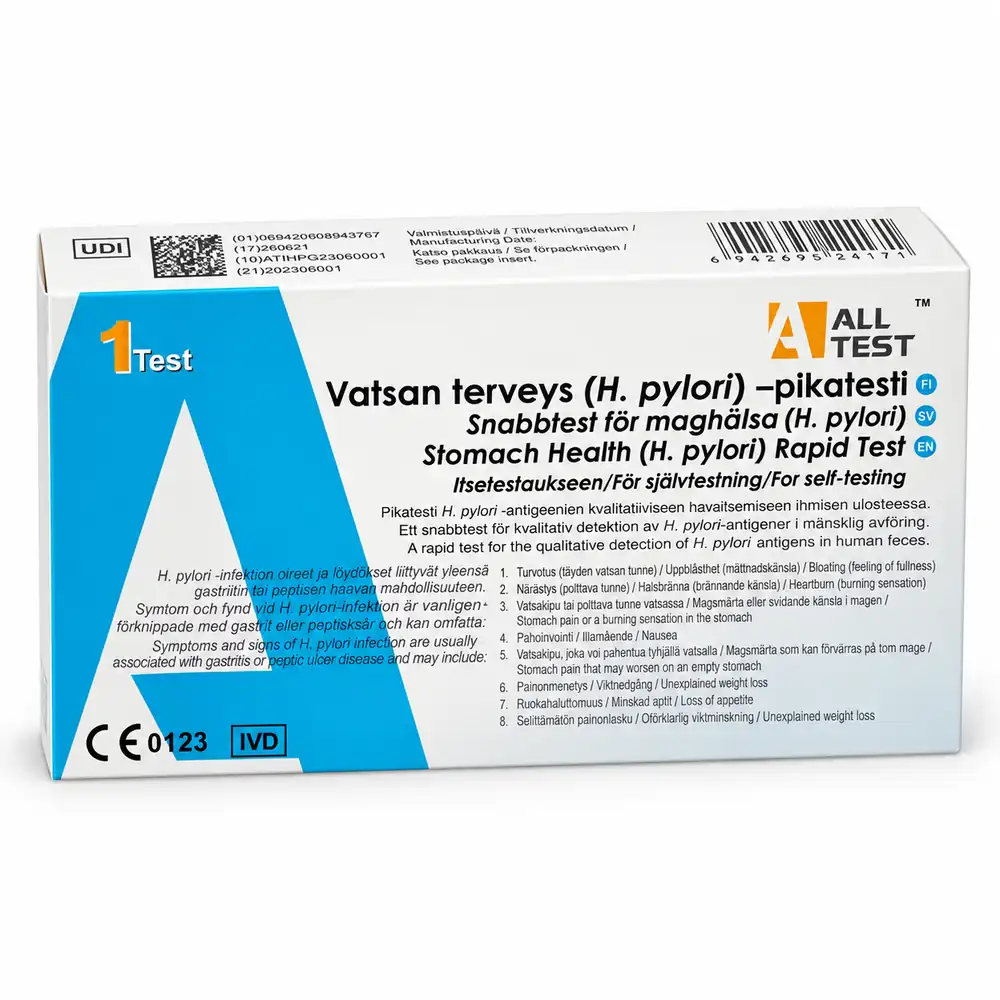
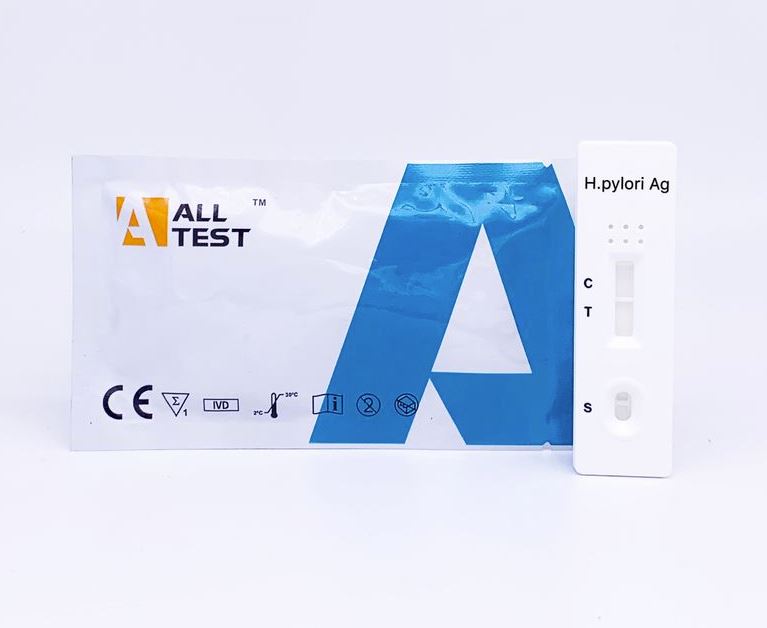



H. pylori stool test is a CE 0123-marked IVD self-test for home use that qualitatively detects Helicobacter pylori (H. pylori) antigens in a stool sample. The result is read at 10 minutes. The test does not measure the amount of antigen and cannot confirm a diagnosis on its own.
Why choose this H. pylori stool test?
The H. pylori stool test allows you to check at home whether H. pylori antigen can be detected in a stool sample. The sample does not need to be sent to a laboratory.
- Result in 10 minutes: read the result directly from the test cassette.
- For home use: CE 0123-marked IVD self-test.
- Stool sample: collect the specimen from three different areas of the stool.
- No dietary restrictions: the IFU does not require a special diet before testing.
- Documented performance: sensitivity was 98.4% and specificity 100.0% in the clinical study reported in the IFU.
What does the H. pylori stool test detect?
The test qualitatively detects H. pylori antigens in stool. The limit of detection, or LoD, is 5 ng/mL.
A positive result means that H. pylori antigen has been detected in the sample. The test does not measure antigen concentration, assess the severity of an infection or confirm a diagnosis on its own.
The test is not intended to detect gastric cancer or other gastrointestinal diseases. Read more about H. pylori testing and treatment in the NIDDK guide.
Who is the test suitable for and when can it be used?
The H. pylori stool test is intended as a self-test for home use when you want to check whether H. pylori antigen can be detected in a stool sample.
The test may be useful, for example, if you have persistent or recurring stomach symptoms. The result should be considered together with your symptoms and overall health and does not replace a medical assessment.
See also our other infection tests.
What should you consider before testing?
According to the IFU, the test can be performed at any time of day and no special dietary restrictions are required before testing.
Certain antibiotic treatments may reduce the amount of H. pylori antigen in stool and cause a false-negative result. If you are taking or have recently taken antibiotics, take this into account when interpreting the result and always follow the instructions supplied with the test.
Do not allow urine to mix with the stool sample. Handle and test the sample according to the instructions after collection.
How to perform the H. pylori stool test
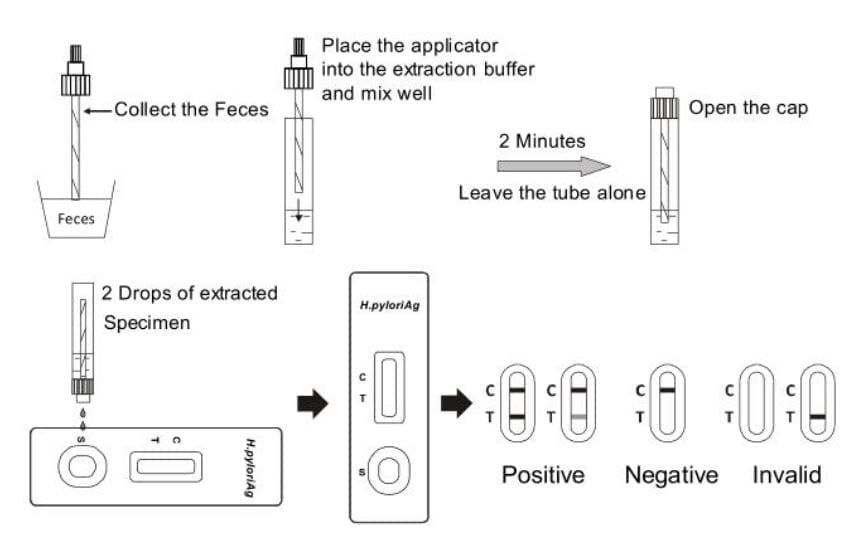
- Collect the stool on the supplied stool collection paper without allowing urine to mix with the sample.
- Unscrew the specimen collection tube and insert the sampling stick into the stool at three different sites. Do not scoop stool into the tube.
- Close the tube, shake it vigorously and allow the sample to react for two minutes.
- Add two full drops to specimen well S on the test cassette.
- Wait 10 minutes and read the result.
Always follow the package insert and instructions for use supplied with the test.
How is the result interpreted?
Positive result: if both the C line and the T line appear, H. pylori antigen has been detected in the sample. A faint T line is also considered positive. Contact a healthcare professional for further assessment.
Negative result: if only the C line appears, H. pylori antigen has not been detected above the test’s detection limit. A negative result does not completely rule out infection. Seek medical advice if symptoms persist.
Invalid result: if the C line does not appear, the result is invalid. Repeat the test with a new test device.
Read the result at 10 minutes. Do not interpret the result after 20 minutes.
How reliable is the H. pylori stool test?
The clinical study reported in the manufacturer’s IFU included 111 participants and used PCR as the reference method.
- Sensitivity: 98.4%
- Specificity: 100.0%
- Overall agreement: 99.1%
- LoD: 5 ng/mL
These performance figures are those reported by the manufacturer for this specific test. No rapid test is infallible, and specimen collection, test procedure and correct use can affect the result.
What is included and how should the test be stored?
The one-test pack contains:
- 1 test cassette
- specimen collection tube with 2 mL dilution buffer
- stool collection paper
- package insert and instructions for use
You will also need a timer.
The product is a CE 0123-marked IVD self-test for home use. Store the kit in a dry place at 2–30 °C. Do not freeze. Use the test cassette within one hour of opening the foil pouch.
Winter delivery: the pack contains liquid buffer that must not freeze. For delivery outside Finland, we recommend Posti delivery to a collection point.
Frequently asked questions about the H. pylori stool test
What does the H. pylori stool test detect?
The test detects H. pylori antigens in a stool sample. It is a qualitative test and does not measure the exact amount of antigen.
How quickly do I get the result?
The result is read at 10 minutes. Do not interpret the result after 20 minutes.
What does a positive result mean?
A positive result means that H. pylori antigen has been detected in the stool sample. Contact a healthcare professional for further assessment.
Can I rely on a negative result?
A negative result means that H. pylori antigen was not detected above the test’s detection limit. It does not completely rule out infection, so seek medical advice if symptoms persist.
Can antibiotics affect the test result?
Yes. Certain antibiotic treatments may reduce the amount of H. pylori antigen in stool and cause a false-negative result. Always follow the instructions in the package insert.
Do I need to follow a special diet before testing?
No. According to the IFU, no special dietary restrictions are required before testing.
Can I perform the H. pylori test at any time of day?
Yes. According to the IFU, the test can be performed at any time of day. Handle and test the sample according to the instructions supplied with the test.
Order an H. pylori stool test
Order the AllTest H. pylori stool test from Testerit and check at home whether H. pylori antigen can be detected in a stool sample. Always follow the instructions supplied with the test.

Reviews
There are no reviews yet.