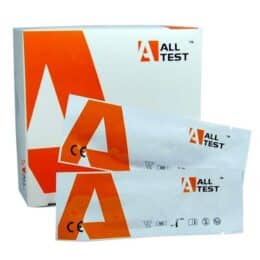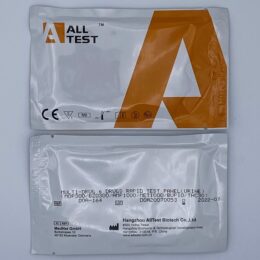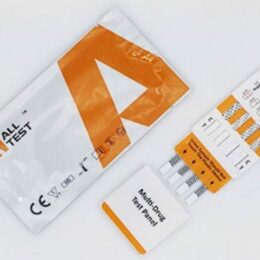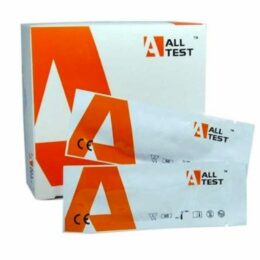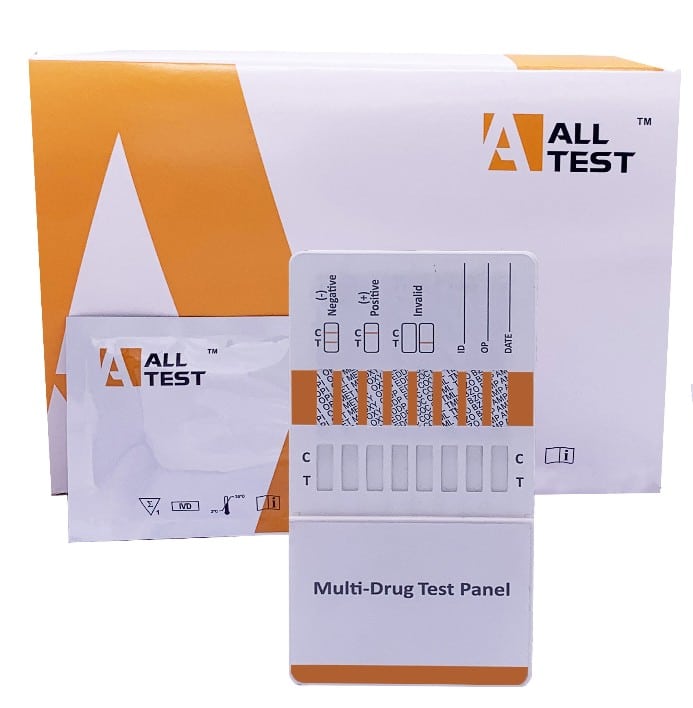
16-panel drug test for materials, urine, liquids and surfaces
This 16-panel drug test provides a rapid, qualitative preliminary screen for unknown or suspicious samples. It can be used with powders, tablets, other solid materials, surface residues, urine and suitable liquid samples. The result is read after approximately 5 minutes.
Which samples can be tested?
- Surfaces: residues on tables, floors, objects or packaging.
- Solid materials: powders, crystals, tablets and other unknown solids.
- Urine: the test instructions include a dedicated urine-sample procedure.
- Liquids: for example an unknown drink, a suspicious spill or puddle on the floor, or a liquid sample taken from a toilet bowl or wastewater inspection chamber.
Always use the sampling method in the enclosed instructions. Strong acids or bases, oxidising agents, corrosion inhibitors and thick oily liquids may interfere with the test and are not suitable samples.
How is a urine sample tested?
- Collect the urine in a clean, dry container.
- Dip the test strips vertically into the sample for 10–15 seconds, up to the wavy lines but not above the arrows.
- Place the test on a flat surface and read the result at 5 minutes. Do not interpret the result after 10 minutes.
What do ETG and COT mean?
ETG (ethyl glucuronide) is a marker formed when the body processes alcohol. The ETG panel can therefore screen a urine sample for a marker of alcohol use.
COT (cotinine) is a marker formed after nicotine exposure. The COT panel can screen a urine sample for a marker of nicotine use.
ETG and COT should not be described as direct measurements of alcohol or nicotine in the sample.
All 16 panels and cut-off levels
| Panel | Substance or marker | Cut-off |
|---|---|---|
| OPI | Opiates / morphine | 300 ng/ml |
| OXY | Oxycodone | 100 ng/ml |
| MET | Methamphetamine | 1000 ng/ml |
| COC | Cocaine metabolite | 300 ng/ml |
| BZO | Benzodiazepines | 300 ng/ml |
| KET | Ketamine | 1000 ng/ml |
| FYL | Fentanyl | 200 ng/ml |
| MDMA | MDMA | 500 ng/ml |
| PGB | Pregabalin | 2000 ng/ml |
| AMP | Amphetamine | 500 ng/ml |
| THC | THC metabolite | 50 ng/ml |
| TML | Tramadol | 100 ng/ml |
| BUP | Buprenorphine | 10 ng/ml |
| ETG | Ethyl glucuronide | 500 ng/ml |
| α-PVP | Alpha-PVP | 300 ng/ml |
| COT | Cotinine | 10 ng/ml |
How are the results interpreted?
- Negative: two coloured lines appear, one in the control region (C) and one in the test region (T). A faint T line is also interpreted as negative.
- Preliminary positive: a control line (C) appears but no test line (T) appears for the relevant panel.
- Invalid: no control line appears. Repeat the test with a new device.
The test is a qualitative preliminary screen. It does not determine the exact concentration or complete composition of a sample. A preliminary positive result can be confirmed with an appropriate analytical laboratory method when required.
When is this test useful?
- When an unknown powder, tablet or residue is found.
- When the contents of a drink or another liquid are unclear.
- When a suspicious liquid or puddle is found on a floor.
- When testing a urine sample for the substances and markers included in the panel.
- When taking an individual liquid sample from a toilet bowl or wastewater inspection chamber.
Why choose this 16-panel test?
- One test screens 16 different substances or markers.
- Includes fentanyl, pregabalin and alpha-PVP.
- Includes ETG and COT for screening alcohol- and nicotine-use markers in urine.
- Suitable for several sample types.
- Results in approximately 5 minutes.
- Clear instructions and anonymous delivery.
Compare drug tests and learn more
Read more about drug testing and result interpretation, compare multi-drug tests, or browse the full selection of drug tests.
If you primarily need a test for powders and surfaces, see the 16-panel surface swab drug test.
Select the right package
Choose 1, 3 or 5 tests from the package buttons above and add the selected package directly to your cart.