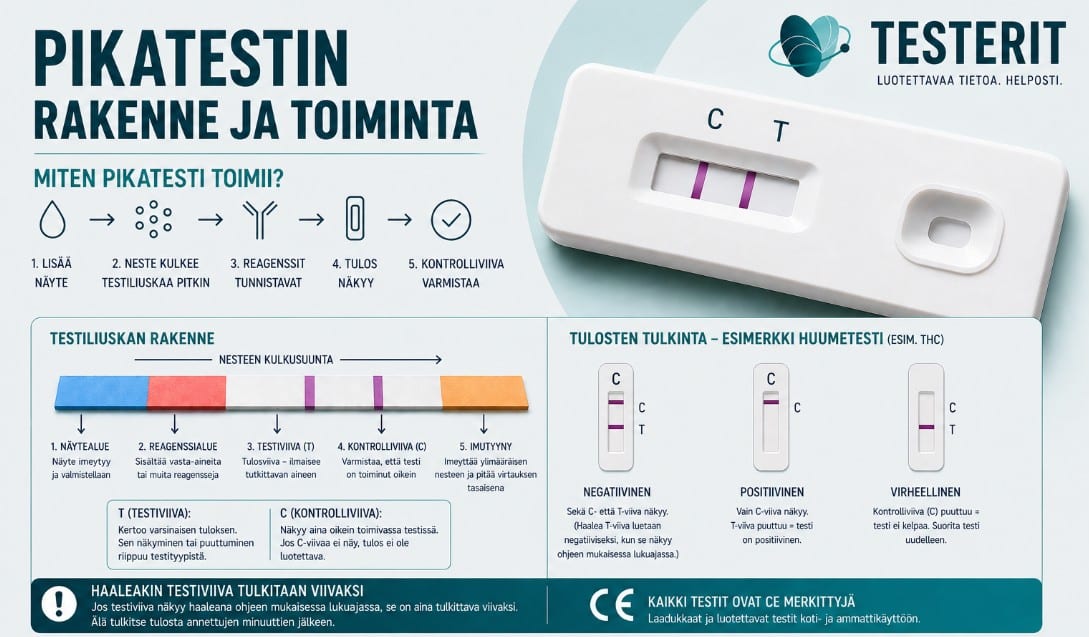
How does the rapid test work? Although the test looks simple, it is based on a carefully designed process in which the liquid passes through the test and reacts with different substances. The result is clearly shown as C and T lines. The image below illustrates how the rapid test works in practice and how the interpretation of drug tests and health tests differs. It is important to understand these differences, as the same lines can mean different things depending on what the test is measuring.

How does a rapid test work? A rapid test looks simple on the outside, but inside it takes place a precisely designed biological or chemical reaction. Most rapid tests are based on the controlled passage of a liquid through a test strip, whereby the reagents in the test identify a specific substance, hormone, marker or compound in the sample.
How a rapid test works in practice depends somewhat on the type of test. Health tests, drug tests, water tests, and DNA tests may be based on different operating principles, even though the basic structure of many rapid tests appears very similar to the user.
This article explains the structure of a rapid test, the significance of the test line and control line, and why, for example, the interpretation of results for a drug test and many health tests may differ. It also covers the most common types of tests and how they differ in practice.
The structure of a rapid test, simply put
Many rapid tests are based on lateral flow technology. Inside the test, there is a thin test strip in which the liquid moves with the help of capillary force. The same basic phenomenon can be seen in nature, for example, in how water rises from the roots of the plant upwards.
A typical lateral flow strip includes a sample pad, reagent region, test line (T), control line (C) and absorbent pad. The sample moves along the strip by capillary action and encounters reagents designed to react with the target substance.
The test line contributes to the result, while the control line indicates that the sample has flowed through the strip as required. A control line does not establish that every testing step was correct. The absorbent pad helps draw liquid through the strip.
How does the rapid test work in practice?
The working principle of a rapid test can be summarized in a clear process. First, the sample is added to the test, after which the liquid begins to travel along the test strip. The reagents identify a potential substance in the sample and form a visible reaction. Finally, the result is shown as a line or the absence of a line in the test area.
Once you understand how the rapid test works, it will be much easier to interpret the results. In particular, it is worth understanding the meaning of the C and T lines before taking the test, because the same number of lines does not always mean the same thing in different test types.
If the control line is not visible at all, the test has not been successful. In this case, the result should not be interpreted, but the test should be done again.
test line and control line – what do C and T mean?
Rapid tests often show the labels C and T. C stands for the control line and T for the test line. The control line should appear whenever the test is working properly.
A faint line is still a line when it appears in the reading time specified in the user manual. This is one of the most important practical things to understand, as many people doubt the result of the test precisely because of the faint line.
Line intensity has several possible causes and does not provide a numerical concentration. Interpret only lines that appear in the required location within the specified reading time, following the particular product’s instructions.
How does a drug test work?
Many rapid drug screens use a competitive immunoassay. The target substance competes with reagents in the test, so a concentration at or above the cutoff can prevent the test line from appearing. Line darkness cannot determine the amount used or impairment.
For this reason, the interpretation of a drug test differs from many other tests. A negative result usually shows both a C and a T line, while a positive result only shows a control line.
A faint test line is interpreted as a line, which effectively means a negative result. This is one of the most common misunderstandings in drug tests.
It is also important to read the result at the right time. A result read too late may change and is no longer reliable.
Drug tests in practice and official use
If you want to deepen the purposes and interpretation of drug tests and who is allowed to test in different situations, read a more extensive guide:
Information about drug tests.
The article on the use of drugs in the authorities and working life discusses, for example, police saliva tests, drug testing at the workplace, and the difference between screening and laboratory analysis:
Drug testing by the authorities and in working life in Finland.
How does a health test work?
Many health tests, including some pregnancy and hormone tests, use a sandwich immunoassay. The target binds to reagents and can form a visible test line.
In many of these tests, a control line alone indicates a negative result and a control line plus a test line indicates a positive result. This pattern does not apply to every health test. Follow the product-specific instructions.
How do different test types work?
How a rapid test works depends on its intended use. Drug tests are based on a competitive reaction, health tests on antibodies, water tests on a chemical color reaction or color comparison, and DNA tests on laboratory analysis.
Understanding these differences helps you interpret the results correctly and avoid drawing incorrect conclusions.
Rapid tests based on chemical reactions
Chemical rapid tests typically display the result as a color change. These are used, for example, to measure water quality when you want to quickly assess the properties of water without laboratory equipment. However, the color, turbidity, or other properties of the sample can affect the readability of the result.
Water tests based on color comparison
Not all rapid tests are based on test lines. In many water tests, the result is based on a chemical color reaction, in which the color tone of the test strip is compared to the included scale. This can be used to assess, for example, pH value, free chlorine, total chlorine, water hardness, alkalinity or other water properties.
In such tests, chemicals have been added to the pads of the test strip that react with substances in the water and change color. The result is therefore not shown as C and T lines, but as the intensity or hue of the color that corresponds to a certain value on the scale.
Water tests may also include several different measurement methods in the same test set. Some measurements are based on a quick colour comparison, some on a chemical reaction, and some may require a longer application time. For example, in a bacterial test, the result may be visible as a discolouration of the liquid over time, which indicates the possible growth of bacteria in the sample.
This highlights the fact that the principle of operation of a quick test is not always the same, even if the test is simple for the user to use. In a line test, the result is interpreted based on C and T lines, while in a water test, the result can be interpreted based on a color chart, a change in shade or a longer reaction time.
DNA tests work differently
DNA tests are laboratory analyses rather than rapid line tests. Their results come from analysis of genetic material.
What affects rapid test reliability?
Reliability depends on the test, correct sample handling, following the instructions and reading the result at the specified time.
For colour-comparison water tests, use the supplied chart in suitable lighting and read at the time specified in the instructions.
How do different test types work?
The operating principle of rapid tests applies to several different types of tests.
Drug tests react to specific substances and their concentrations, but their operating principle is often based on what is known as a competitive reaction, in which the more of the substance being tested is present in the sample, the fainter the test line appears.
Health tests are based on the detection of biomarkers,
water tests on a chemical color reaction or color comparison, and
DNA tests work differently: in these, the sample is collected by the user, but the analysis is performed in a laboratory, and the result is not displayed as test lines.
More information can also
be foundin the
description of lateral flow tests and
on the website of the Finnish Institute for Health and Welfare.
Summary
In summary, how the rapid test works is based on the flow of the fluid and the ability of the reagents to identify substances. The results can appear as lines, color change, or color comparison, depending on the type of test.
Follow the instructions: faint T lines can be negative in drug screens.
by authorities
Frequently asked questions
How does a rapid test work in short?
A rapid test identifies a specific substance in a sample through a biological or chemical reaction. The liquid passes through the test strip and the result is usually shown as lines or discoloration.
What does C and T mean in a quick test?
C stands for control line and T stands for test line. The control line must be visible for the test to have worked correctly. The meaning of the test line depends on the type of test.
What does a faint line mean in a rapid test?
Follow the product’s instructions for lines appearing within the reading window. In many competitive drug screens, a visible T line, even faint, indicates a negative screen when the C line is also present. In many sandwich immunoassays, a faint T line with a C line indicates a positive result. A missing C line makes the result invalid.
Why can a faint line be negative in a drug test?
Drug tests work on a competitive basis. If the T-line is even faint, the result is usually negative, because the concentration of the substance is below the limit value of the test.
Is the result of the rapid test always certain?
The rapid test gives a quick result, but it is affected by sampling, use and reading time of the result. If necessary, the result can be confirmed with a laboratory test.
Do DNA tests work the same way as rapid tests?
No, they don’t. DNA tests are analyzed in a laboratory and the result is not shown as test lines. They are based on genetic analysis.