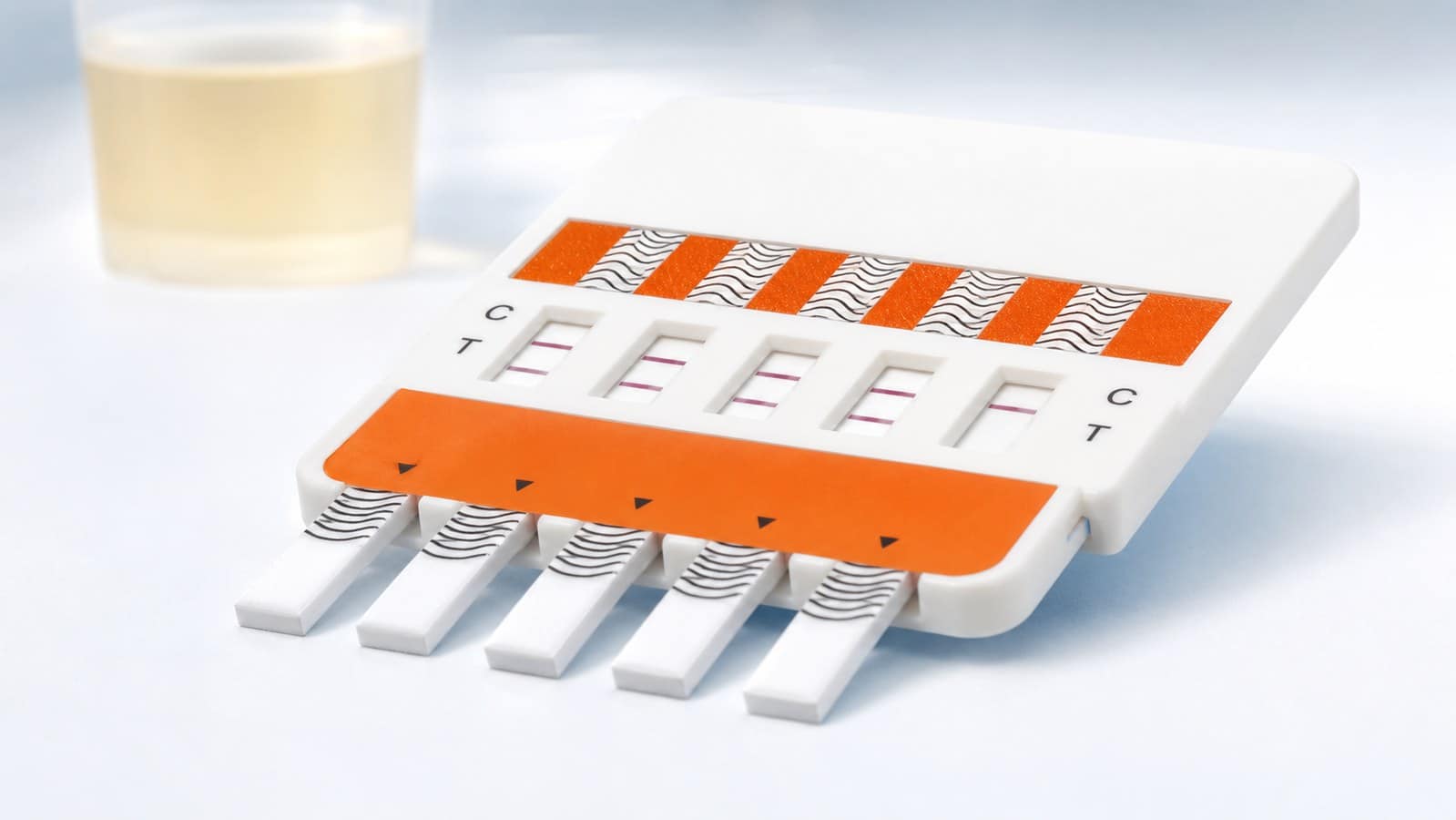
A drug screen is a rapid test that examines whether the sample contains a drug or its metabolite identified by the test at least equal to the cutoff value indicated in the test. If the concentration is at or above the limit value, the screening result is positive. If the concentration is below the limit value, the test may show a negative result even if there is a small amount of the substance in the sample. The drug screen does not indicate the exact concentration, amount of use, time of use or state of intoxication.
How does a drug screen work as a rapid test?
Most rapid drug tests are based on the immunochromatographic method. The antibodies on the test strip react with the substance or metabolite in the sample. The result is read at the time indicated in the instructions for use of the test, usually within a few minutes.
The rapid test is a first-step screening method. It answers a limited question: does the concentration of the substance detected by the test exceed the limit value of the test in question? It does not measure the concentration as an exact number. See also how the test lines and immunochromatographic method of the rapid test work.
What does the drug screening threshold mean?
The cutoff is the concentration used to classify the screening result. A substance or metabolite at or above that cutoff may produce a positive screen. A concentration below it may produce a negative result even when some of the substance is present.
A negative result does not mean that there is definitely no substance in the sample. The substance may be below the test’s detection limit, the sample may have been taken outside the observation window, or the test panel may not detect the substance in question. The limit value, sample type and substances identified by the test are always checked in the instructions for use of the product in question.
What substances does the drug screen identify?
A drug screen only identifies substances or their metabolites that are named in the test panel and instructions for use. A single drug test targets a single group of substances, while a multi-drug screen can examine several groups of substances with the same sample.
When choosing a test, you must check at least the sample type, the substances in the test panel, the limit values, the purpose of use and the user group. Compare the selection of drug tests and check each product’s intended use before choosing a test.
How is the result of a drug screening read?
Follow the specific product’s instructions. In many rapid drug tests based on a competitive immunoassay, results are interpreted as follows:
- Negative screening result: the control line and the test line are visible. A faint test line generally has the same interpretation as a clearly visible line if the line is readable within the time specified in the instructions for use.
- Positive screening result: the control line is visible, but the test line is not visible. The concentration of the identified substance may be at or above the limit value of the test.
- Invalid result: the control line does not appear. The test is then not interpretable, but the procedure is checked in the instructions for use and the test is repeated if necessary.
Confirm unexpected positive screening results, and results with significant consequences, using an appropriate laboratory method. Workplace and legal testing must also meet the applicable local requirements; a rapid screen alone is insufficient.
Detection windows
Detection time refers to the period during which a substance or its metabolite may exceed the limit value of the test used. Time is not the same as the duration of intoxication or effect. The detection window is affected by the substance, the type of sample, the limit value of the test, the amount and frequency of use, metabolism, the quality of the sample and the time since the last use.
The approximate urine immunoassay detection windows below come from Finnish Current Care (Käypä hoito) guidance. They are general estimates and do not establish the performance of a particular rapid test:
| Substance or group of substances | Indicative detection time in urine |
|---|---|
| Amphetamine | usually 2–6 days |
| Methamphetamine | usually 2–6 days |
| MDMA | usually 1–3 days |
| Cocaine | usually 1–4 days |
| Morphine | usually 1–7 days |
| Cannabis | approximately 1–5 days after occasional use, 5–14 days after regular use, and 14 to more than 30 days after heavy long-term use |
| Benzodiazepines | vary from about 1 to 30 days, depending on the drug |
Long-term use at high doses may prolong the detection time. Substances can usually be detected in saliva for a shorter period of time than in urine. Always check the product-specific sample type, limit value and restrictions in the instructions for use. A more extensive summary can be found on the page Drug test function, detection times and interpretation of results. For background to the time limits, see also Current care: Time limits for drug tests.
How does a drug screen differ from a laboratory test?
A rapid drug test provides a qualitative screening result quickly, while the laboratory can identify the substance with a more accurate verification method and, if necessary, determine the concentration. A rapid test is not a substitute for a confirmatory analysis in a situation where the result has medical, legal, work-related or other significant consequences.
Drug testing typically has two stages: first, screening is carried out and a positive finding is confirmed by a reliable laboratory analysis. Even a negative result must be assessed in relation to the test panel, the cut-off value and the time of sampling.
What factors can affect the result of a drug screening?
- Sampling time: the concentration may be too low immediately after use or after the detection window has already closed.
- Test cut-off value: concentrations below the limit will not be shown as a positive screening result.
- Test panel: the test does not detect substances that are not included in the panel.
- Sample quality: for example, a strong dilution of urine may affect the result.
- Storage and use: incorrect temperature, outdated test or reading the result at the wrong time can make the result unreliable.
- Cross-reactions: certain drugs or compounds can affect the result of immunological screening.
When can a rapid drug test be used?
A rapid drug test is suitable for preliminary screening according to the manufacturer’s intended use when there is a need for quick information on the substances in the test panel in relation to their limit values. The test does not prove use or non-use, nor does it indicate a state of intoxication.
Choose a rapid test based on the substances you want to screen, the sample from which the test is performed and who the product is intended for. First, familiarise yourself with the drug test info, check the operating principle of the rapid test and then compare multi-drug screens.