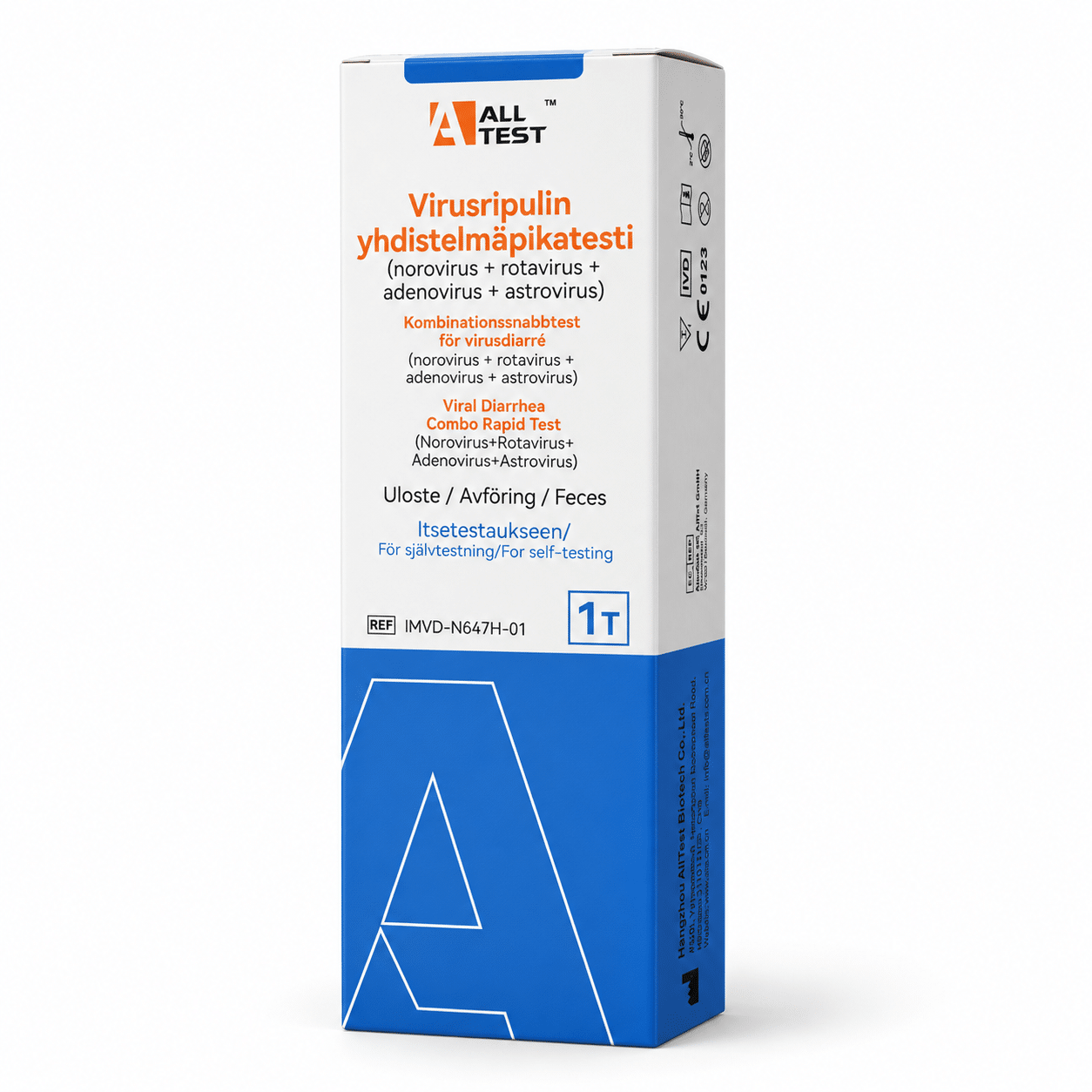
Home test detects norovirus, rotavirus, adenovirus and astrovirus antigens in a stool sample. Separate results for four viruses, read after 15 minutes.
The AllTest Viral Diarrhea Combo Rapid Test is intended for self-testing in situations where you want to find out whether antigens of one of the four viruses covered by the test are detected in the stool sample. The test provides a preliminary result and does not alone confirm the cause of stomach symptoms.
Why choose this stomach flu test?
- One test examines four gastroenteritis viruses
- Detects norovirus, rotavirus, adenovirus, and astrovirus antigens
- The test is done from a stool sample
- Separate result for each virus
- The result is read in 15 minutes
What does a stomach flu test detect?
The stomach flu test qualitatively detects antigens of four viruses in a human stool sample:
- Norovirus – genogroups GI and GII
- Rotavirus
- Adenovirus
- Astrovirus
This is a qualitative lateral flow immunoassay. The result indicates whether the antigen of the virus in question is detected in the sample. The test does not measure the amount of antigen or the change in the concentration of the virus.
The test only detects these four viruses. A negative result does not rule out infection, especially if the concentration of virus particles in the sample is low.
Who is the stomach flu test suitable for and when should it be done?
The test is intended for self-testing in situations where you want to test a stool sample for norovirus, rotavirus, adenovirus or astrovirus antigens.
According to the manufacturer’s instructions for use, the test can be used at home in case of symptoms suitable for stomach flu, such as acute gastroenteritis or diarrhoea, to determine whether any of the four viruses covered by the test are detected in the sample.
If the symptoms are severe or prolonged, or if the risk of dehydration increases, seek a health care assessment regardless of the test result.
What should be taken into account in testing?
The stool sample should be collected in a clean and dry container or on the sample paper provided with the package. No dietary restrictions are required prior to the test.
The test should be performed immediately after the stool sample has been collected. Allow the test cup to warm up to room temperature, 15–30 °C, before performing the test.
Once the test cup is removed from the foil pouch, it should be used as soon as possible. The manufacturer recommends using the test cup within one hour of opening the foil pouch.
According to the manufacturer’s IFU, a stool sample from a child under one year of age may give a false positive norovirus result. Concomitant positive adenovirus and rotavirus results in newborns should be interpreted with caution.
The test cup contains a liquid dilution buffer. The buffer should not be drunk and skin and eye contact should be avoided. The test should not be frozen.
How to do a stomach flu test
- Collect the stool sample in a clean and dry container or on the sample paper provided with the package. Avoid getting urine into the sample.
- Unscrew the lid of the test cup and take out the swab.
- From solid stools, insert the swab randomly into three different places. Do not scrape the stool into the swab.
- For liquid stool, hold the pipette upright and transfer two drops of the sample to a test cup with a dilution buffer.
- Insert the swab back into the test cup and screw the lid shut.
- Shake the test cup for about 10-15 seconds to mix the contents properly.
- Let the test cup sit for 2 minutes.
- Remove the plastic cap from the bottom of the test cup, place the cup on a clean and flat surface, and press the cup from top to bottom to start the test.
- Start the timer and keep the test cup in an upright position throughout the test.
- Read the result after 15 minutes. Do not interpret the result after 20 minutes.
Always follow the instructions for use provided with the package.
Directions for use
Select user manual language (PDF): Suomi · Svenska · English
How is the result of a stomach flu test interpreted?
The test has four separate result windows: Noro, Rota, Adeno and Astro. The result of each virus is interpreted separately.
Positive result: two lines appear in the test area in question. A colored line appears in control area C and another colored line appears in test area T. This means that the antigen of the virus in question has been detected in the stool sample.
The color intensity of the test line may vary depending on the antigen content of the sample. A visible T-line is interpreted as positive, regardless of how weak or strong the line is.
Negative result: one colored line is shown in control area C, but no line is visible in test area T. This means that no antigen of the virus in question was detected.
Invalid result: if control line C is not formed, the result cannot be interpreted. Common reasons include too low a sample volume or an error in performing the test. The test must be repeated with a new test.
In the event of a positive result, the manufacturer recommends that you seek medical attention and show the test result. If necessary, a healthcare professional will assess the need for further examinations.
If the result is negative but the symptoms persist, seek a health care assessment.
How reliable is the stomach flu test?
The clinical performance data reported in the manufacturer’s IFU are:
- Rotavirus: sensitivity 98.0%, specificity 98.0% and total relevance 98.0%. The study had 150 participants and the reference method was PCR.
- Adenovirus: sensitivity 96.0%, specificity 99.0% and total relevance 98.0%. The study had 150 participants and the reference method was PCR.
- Norovirus: sensitivity 98.1%, specificity 99.2%, and overall match 99.0%. The study had 302 participants and the reference method was ELISA.
- Astrovirus: sensitivity 95.2%, specificity 99.2% and overall relevance 98.3%. The study had 302 participants and the reference method was ELISA.
The limits of the test according to the manufacturer’s IFU are:
- Rotavirus: 50 ng/ml
- Adenovirus: 25 ng/mL
- Norovirus GI: 25 ng/ml
- Norovirus GII: 20 ng/ml
- Astrovirus: 350 ng/ml
Performance data is based on tests provided by the manufacturer. Individual test results can be affected by, for example, sampling, sample volume, and correct test execution.
What’s in the pack and how do I store the test?
- 1 test cup with 2 ml dilution buffer
- 1 stool sample paper
- 1 pipette
- 1 Instruction Manual
In addition, you will need a timer.
Store the test in a dry place between 2°C and 30°C. The test should be stored in a sealed foil bag until use and should not be frozen. Do not use the test after the expiration date or if the package is damaged or opened.
Frequently asked questions about the stomach flu test
What does the stomach flu test examine?
The stomach flu test examines the stool sample for norovirus, rotavirus, adenovirus and astrovirus antigens. For norovirus, the test identifies the genogroups GI and GII.
Also Is this a norovirus test?
Yes. The test examines not only norovirus, but also rotavirus, adenovirus, and astrovirus, making it a broader option than just a norovirus test.
How fast is the result ready?
The result is read after 15 minutes. The result should not be interpreted after 20 minutes.
Is a special diet required before the test?
No. According to the manufacturer’s instructions for use, no dietary restrictions are required before the test.
What does a positive result mean?
A positive result means that the antigen of the virus in question has been detected in a stool sample. The result is preliminary, and a healthcare professional can assess the need for further tests if necessary.
What does a negative result mean?
A negative result means that the antigen of the virus in question was not detected. However, a negative result does not rule out infection, especially if the concentration of virus particles in the sample is low.
Does the test examine all causes of stomach flu?
No. The test detects norovirus, rotavirus, adenovirus, and astrovirus antigens. It does not look for other possible causes of stomach symptoms or diarrhea.
Order a stomach flu test for home use from the Testerit online store when you want to test one stool sample for norovirus, rotavirus, adenovirus and astrovirus antigens with the same test.