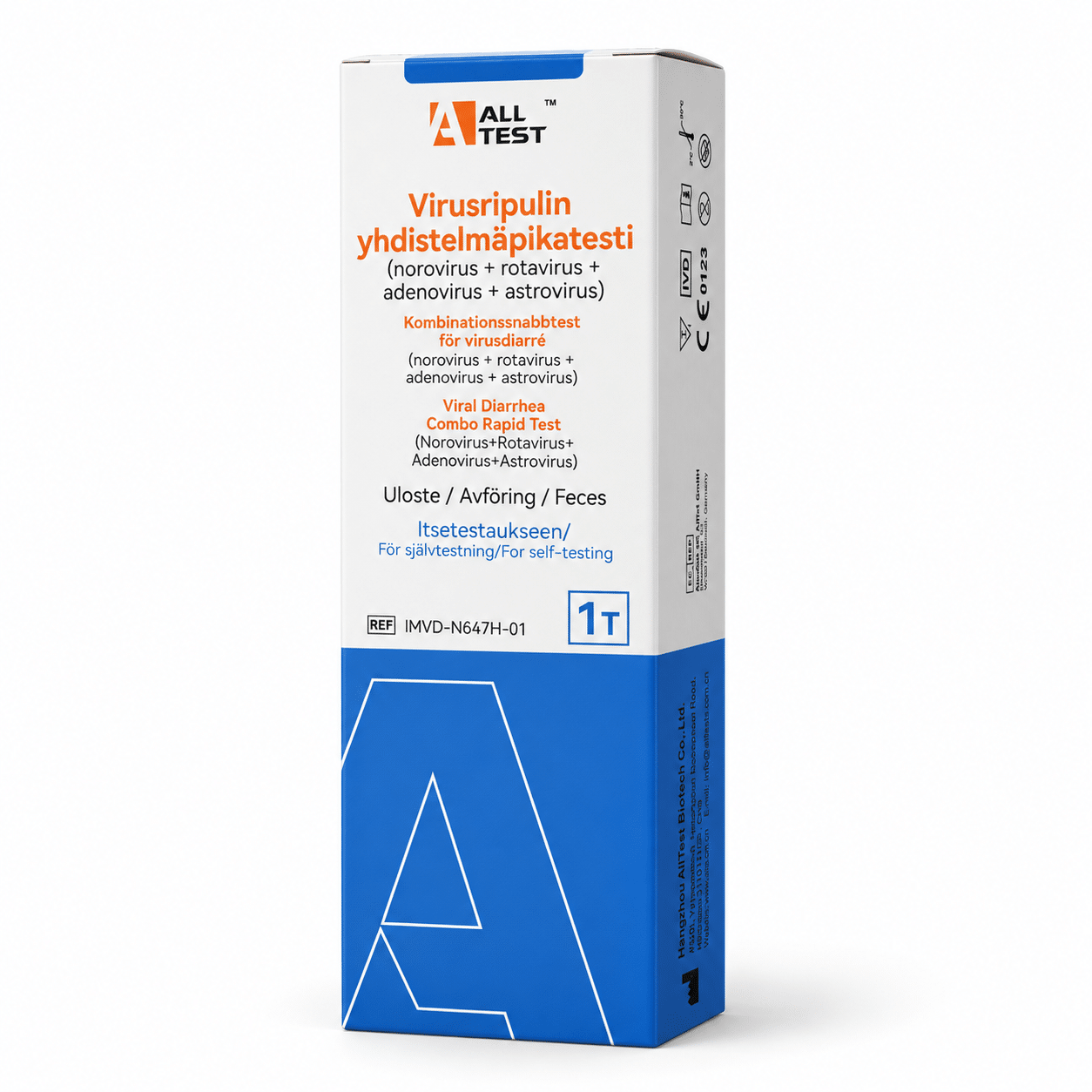
Stomach flu test for home use qualitatively detects norovirus, rotavirus, adenovirus and astrovirus antigens in human stool. One stool sample provides separate results for four viruses, and the results are read after 15 minutes.
The AllTest Viral Diarrhea Combo Rapid Test is intended for self-testing when you want to find out whether antigens from any of the four viruses covered by the test can be detected in a stool sample. These viruses can be associated with viral gastroenteritis. The test provides a preliminary result and cannot on its own confirm the cause of gastrointestinal symptoms.
Why choose this stomach flu test?
- Tests for four viruses with one stool sample
- Detects norovirus, rotavirus, adenovirus and astrovirus antigens
- Separate result for each virus
- Results are read after 15 minutes
- Designed for self-testing at home
What does the stomach flu test detect?
The stomach flu test qualitatively detects antigens from four viruses in a human stool sample:
- Norovirus – genogroups GI and GII
- Rotavirus
- Adenovirus
- Astrovirus
This is a qualitative lateral flow immunoassay. The result indicates whether antigen from the relevant virus is detected in the sample. The test does not measure the amount of antigen or changes in virus concentration.
The test detects only these four viruses. A negative result does not rule out infection, especially if the concentration of virus particles in the sample is low.
Who is the stomach flu test for and when can it be used?
The test is intended for self-testing when you want to examine a stool sample for norovirus, rotavirus, adenovirus or astrovirus antigens.
According to the manufacturer’s instructions for use, the test can be used at home when symptoms are consistent with acute gastroenteritis or diarrhoea and you want to check whether one of the four viruses covered by the test can be detected in the sample.
If symptoms are severe or prolonged, or if there is a risk of dehydration, seek medical advice regardless of the test result.
What should be considered before testing?
Collect the stool sample in a clean, dry container or on the stool collection paper supplied with the test. No dietary restrictions are required before testing.
The test should be performed immediately after the stool sample has been collected. Allow the test cup to reach room temperature, 15–30 °C, before performing the test.
Once the test cup has been removed from the foil pouch, use it as soon as possible. The manufacturer recommends using the test cup within one hour of removing it from the foil pouch.
According to the manufacturer’s IFU, stool samples from infants under one year of age may produce a false positive norovirus result. Simultaneous positive adenovirus and rotavirus results in newborns should be interpreted with caution.
The test cup contains a liquid dilution buffer. Do not drink the buffer and avoid contact with the skin and eyes. The test must not be frozen.
How to perform the stomach flu test
- Collect the stool sample in a clean, dry container or on the stool collection paper supplied with the test. Avoid contaminating the sample with urine.
- Unscrew the lid of the test cup and remove the sampling stick.
- For solid stool, insert the sampling stick into three different areas of the stool sample. Do not scoop stool onto the stick.
- For liquid stool, hold the pipette vertically and transfer two drops of the sample into the test cup containing the dilution buffer.
- Return the sampling stick to the test cup and screw the lid on securely.
- Shake the test cup for approximately 10–15 seconds to mix the contents thoroughly.
- Allow the cup to stand for 2 minutes.
- Remove the plastic seal from the bottom of the test cup, place the cup on a clean, flat surface and press the cup from top to bottom to start the test.
- Start the timer and keep the test cup upright throughout the test.
- Read the results after 15 minutes. Do not interpret the results after 20 minutes.
Always follow the instructions for use supplied with the product.
How are the stomach flu test results interpreted?
The test has four separate result windows: Noro, Rota, Adeno and Astro. The result for each virus is interpreted separately.
Positive result: two lines appear in the relevant test window. One coloured line appears in the control area C and another coloured line appears in the test area T. This means that antigen from the relevant virus has been detected in the stool sample.
The colour intensity of the test line may vary depending on the antigen concentration in the sample. Any visible T line should be interpreted as positive, regardless of how faint or strong the line appears.
Negative result: one coloured line appears in the control area C, but no line appears in the test area T. This means that antigen from the relevant virus was not detected.
Invalid result: if the control line C does not appear, the result cannot be interpreted. Insufficient sample volume or an incorrect test procedure are common causes. Repeat the test using a new test kit.
If the result is positive, the manufacturer recommends seeking medical advice and showing the test result to a healthcare professional. Further testing may be recommended if necessary.
If the result is negative but symptoms persist, seek medical advice.
How reliable is the stomach flu test?
The clinical performance data reported in the manufacturer’s IFU are:
- Rotavirus: sensitivity 98.0%, specificity 98.0% and overall accuracy 98.0%. The study included 150 participants and PCR was used as the reference method.
- Adenovirus: sensitivity 96.0%, specificity 99.0% and overall accuracy 98.0%. The study included 150 participants and PCR was used as the reference method.
- Norovirus: sensitivity 98.1%, specificity 99.2% and overall accuracy 99.0%. The study included 302 participants and ELISA was used as the reference method.
- Astrovirus: sensitivity 95.2%, specificity 99.2% and overall accuracy 98.3%. The study included 302 participants and ELISA was used as the reference method.
The limits of detection (LoD) reported in the manufacturer’s IFU are:
- Rotavirus: 50 ng/ml
- Adenovirus: 25 ng/ml
- Norovirus GI: 25 ng/ml
- Norovirus GII: 20 ng/ml
- Astrovirus: 350 ng/ml
The performance data are based on studies reported by the manufacturer. An individual test result may be affected by factors such as sample collection, sample volume and correct test performance.
What is included in the pack and how should the test be stored?
- 1 test cup containing 2 ml dilution buffer
- 1 stool collection paper
- 1 pipette
- 1 instructions for use leaflet
You will also need a timer.
Store the test in a dry place at 2–30 °C. Keep the test sealed in its foil pouch until use. Do not freeze the test and do not use it after the expiry date or if the packaging is damaged or opened.
Frequently asked questions about the stomach flu test
What does the stomach flu test detect?
The stomach flu test detects norovirus, rotavirus, adenovirus and astrovirus antigens in a stool sample. For norovirus, the test detects genogroups GI and GII.
Is this also a norovirus test?
Yes. The test detects norovirus as well as rotavirus, adenovirus and astrovirus, making it a broader option than a test that detects norovirus alone.
How quickly are the results available?
The results are read after 15 minutes. They should not be interpreted after 20 minutes.
Do I need to follow a special diet before testing?
No. According to the manufacturer’s instructions for use, no dietary restrictions are required before the test.
What does a positive result mean?
A positive result means that antigen from the relevant virus has been detected in the stool sample. The result is preliminary, and a healthcare professional can assess whether further testing is needed.
What does a negative result mean?
A negative result means that antigen from the relevant virus was not detected. However, a negative result does not rule out infection, especially if the concentration of virus particles in the sample is low.
Does the test detect all causes of stomach flu?
No. The test detects norovirus, rotavirus, adenovirus and astrovirus antigens. It does not test for other possible causes of gastrointestinal symptoms or diarrhoea.
Order the stomach flu test for home use from Testerit when you want to test one stool sample for norovirus, rotavirus, adenovirus and astrovirus antigens with a single test.