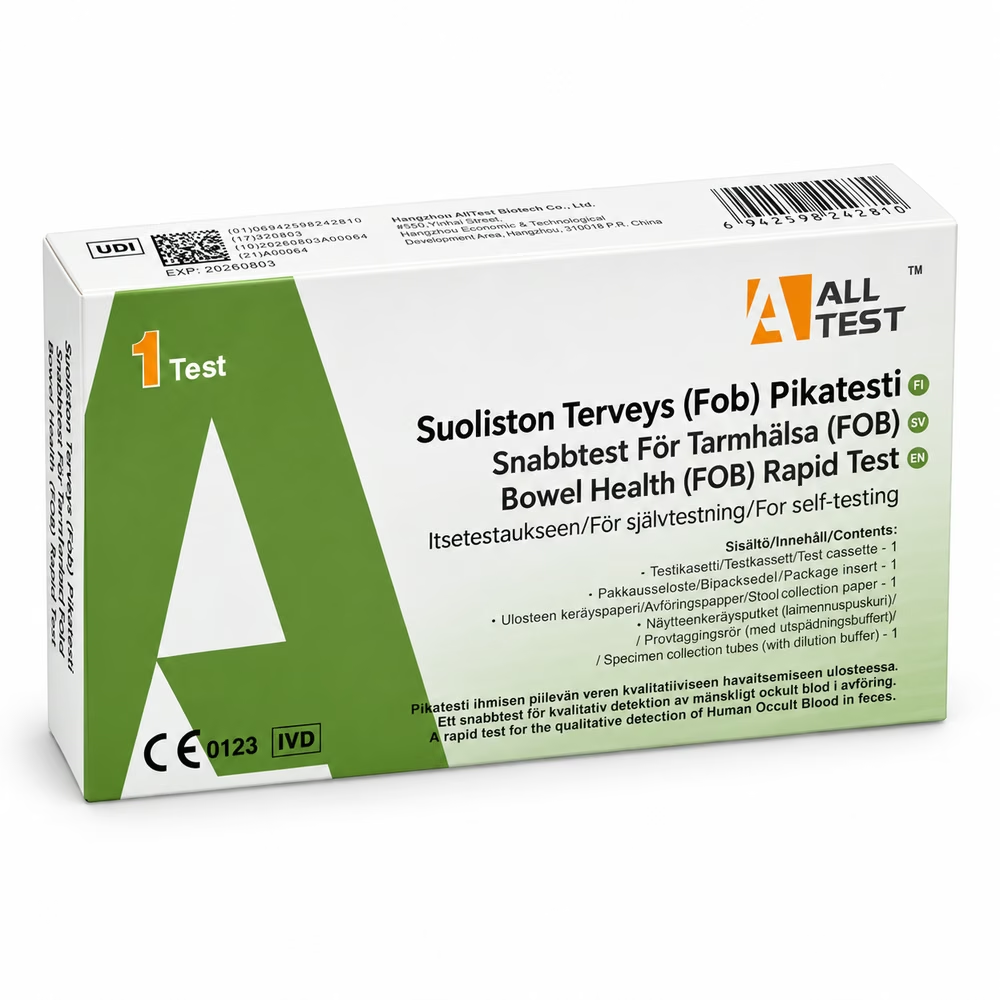
The faecal occult blood test is a home IVD self-test that qualitatively detects human blood in the stool. The cut-off value of the test is 50 ng/ml, or 6 μg/g, and the result is read in 5 minutes.
Why choose this fecal occult blood test?
- For home use: the test is performed on one stool sample.
- Quick result: the result is read in 5 minutes.
- Clear limit value: 50 ng/ml, or 6 μg/g.
- No dietary restrictions: the test can be done without a special diet.
- Easy to interpret: the result is shown as C and T lines on the test cassette.
What does the fecal occult blood test detect?
The test qualitatively detects human blood in the stool with a cut-off value of 50 ng/ml, or 6 μg/g. FOB stands for faecal occult blood, i.e. blood in the stool that is invisible to the naked eye.
The test tells you whether blood is detectable in the sample, but it does not determine the cause of the bleeding and does not confirm the disease on its own. It is not intended to detect colon and rectal tumours or other tumours of the gastrointestinal tract on its own.
Who is the test suitable for and when should it be done?
The FOB home test is suitable for situations where you want to find out if there is blood in the stool that is invisible to the naked eye. The test is performed from a single stool sample at home according to the instructions for use on the package.
A positive result does not indicate the cause of the bleeding, so the result must be assessed by a health care provider.
How does the FOB test relate to colorectal cancer screening?
The examination of fecal occult blood is also used in colorectal cancer screening, because changes in the intestine may be accompanied by minor bleeding that cannot be seen with the naked eye.
This FOB home test detects blood in the stool, but a positive result does not mean that it is bowel cancer. Blood can be caused by a variety of causes, and the test cannot determine the origin of the bleeding.
Also, a negative result certainly does not rule out bowel disease or colorectal cancer, as bleeding may be intermittent. If symptoms occur or you are concerned about colorectal cancer, seek an assessment by a health care provider.
Milloin näytettä ei pidä ottaa?
Do not take a sample during or within three days after menstruation, for bleeding hemorrhoids, or when there is blood in the urine.
Heavy alcohol, aspirin and some medications can irritate the gastrointestinal tract and cause latent bleeding. The package leaflet advises avoiding these substances for at least 48 hours before the test. Do not stop taking prescription medication without the advice of a healthcare professional.
How to do the FOB at-home test
- Collect the faeces on the collection paper provided with the package.
- Use a stick in the collection tube to take a sample from three different parts of the stool.
- Close the tube, shake it, and allow the sample to react for 2 minutes.
- Add two full drops to the sample well of the test cassette.
- Read the result at 5 minutes. Do not interpret the result after 10 minutes.
Always follow the instructions for use provided with the package.
Directions for use
Select user manual language (PDF): Suomi · Svenska · English
How is the result interpreted?
Positive result: both the C and T lines appear. A positive result means that blood has been detected in the sample. The result must be evaluated by a healthcare professional. Any visible T line is considered positive, regardless of its intensity.
Negative result: only the C-line appears. A negative result means that no blood was detected in the sample in excess of the test limit.
Invalid result: if no C-line is formed, the test has not worked correctly and the test must be repeated with a new test.
How reliable is the fecal occult blood test?
In a clinical study with 110 participants, the test had a sensitivity of 98.3%, a specificity of 98.0%, and an overall relevance of 98.2%.
However, a negative result does not rule out bleeding, as bleeding can be intermittent. The test is also less sensitive to upper gastrointestinal blood. If symptoms persist, seek a healthcare evaluation.
What’s in the pack and how do I store the test?
Package Includes:
- test cartridge
- Collection tube with 2 ml buffer
- recycled paper
- package leaflet
In addition, you will need a timer.
Store the test between 2°C and 30°C. Do not freeze.
Frequently asked questions about the fecal occult blood test
What does FOB mean?
FOB stands for hidden blood in the stool, i.e. invisible to the naked eye. The abbreviation stands for faecal occult blood.
Can a FOB test be used to diagnose colorectal cancer?
No. The FOB test detects blood in the stool, but it cannot tell the cause of the blood or diagnose colorectal cancer. However, faecal blood tests are used in colorectal cancer screening.
What does a positive FOB test mean?
A positive result means that the amount of blood in the stool sample exceeds the limit value of the test. The result does not indicate the cause of the bleeding, so it must be assessed by a healthcare provider.
What does a negative result mean?
A negative result means that no blood was detected in the sample in excess of the test limit. However, a negative result does not completely rule out intermittent bleeding. If symptoms persist, seek an assessment by a healthcare professional.
How fast is the result ready?
The result is read at 5 minutes. The result should not be interpreted after 10 minutes.
Do I need to follow a special diet before the test?
No, you don’t. The test can be done without any special dietary restrictions.
Can the test be done during menstruation?
No. The sample should not be taken during or within three days after menstruation.
What should I do if the result is positive?
A positive result must be assessed by a health care provider. The test detects blood in the stool, but does not determine its cause.
Order a home test for fecal occult blood and do the test at home according to the instructions on the package.